Branchial (Pharyngeal) Arches

Stacks Image 199

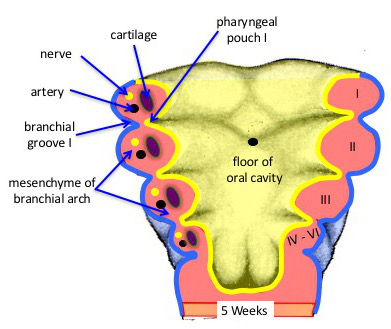
A horizontal cut through the head region of a 5 week old embryo reveals the structure of the branchial apparatus.
Each
branchial arch consists of:

  • Branchial Groove - Ectodermal lined surface groove
  • Pharyngeal Pouch - Endodermal lined outgrowth of the developing pharynx
  • Branchial Arch - Mesodermal core
    • neural crest that gives rise to cartilage to form skeletal components
    • mesenchyme to form muscles and CT
  • Nerve - supplies the specific muscles derived from each arch
  • Artery - forms the major vascular

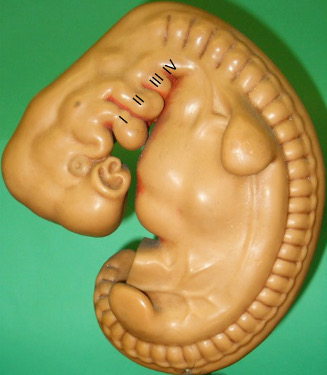
The branchial arches, also called the pharyngeal arches, are a feature of the head region of the developing embryo. They contribute significantly to the formation of structures in the head and neck. In the image of a wax model of a 5-week old embryo to the left, the developing branchial arches are indicated by Roman numerals, I to IV. In humans an additional arch, arch VI, s thought to develop. A fifth arch is thought to have a transient existence and for all practical purposes, arches IV, V and VI are lumped together.

Stacks Image 206
  • Branchial (Pharyngeal) Arch I

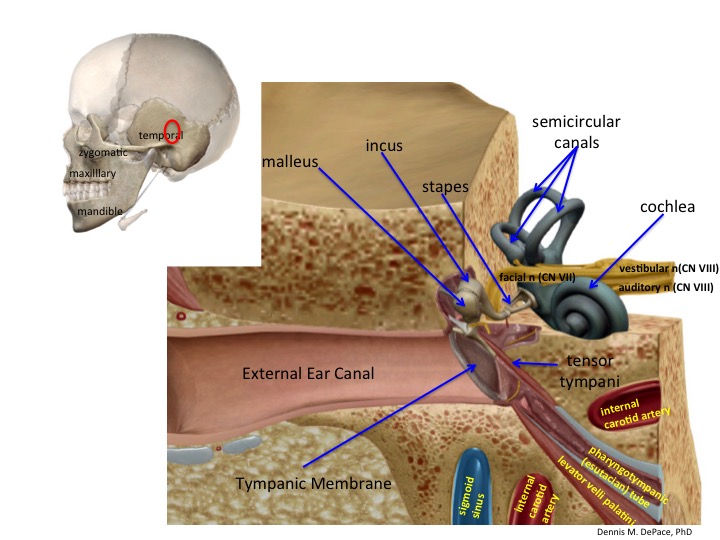
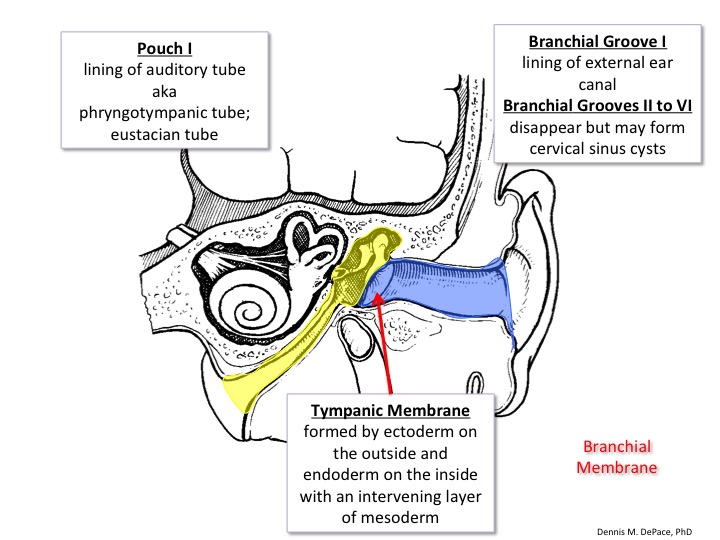
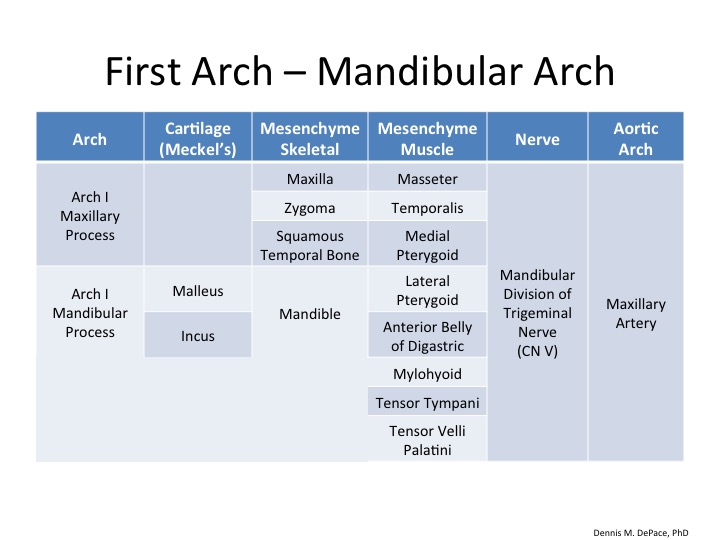
    The first branchial arch (Arch I) is also known as the Mandibular Arch. It divides into maxillary and mandibular processes. The first arch cartilage largely disappears, except for its most proximal part, which forms two bones of the middle ear cavity. Its mesenchyme provides several sets of muscles and its pouch forms the endodermal lining of middle ear cavity and pharyngotympanic tube. The first branchial groove forms the lining of the external ear and outer surface of the eardrum.

    Cartilage

    The cartilage of the first arch, like that of the other arches, is derived from neural crest cells. It is called Meckel’s cartilage and it largely regresses, except for the proximal portion. which gives rise to the malleus and incus of the middle ear.
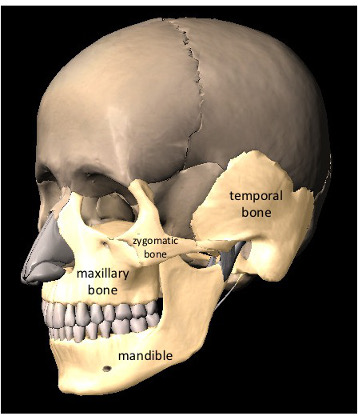
    In the maxillary process, mesenchyme, largely derived from neural crest, undergoes
    intramembranous ossification to produce:

    • maxillary bone
    • zygomatic bone
    • temporal bone
    Mesenchyme of the mandibular process forms the mandible.

    Stacks Image 153

    Mesenchyme

    Stacks Image 58

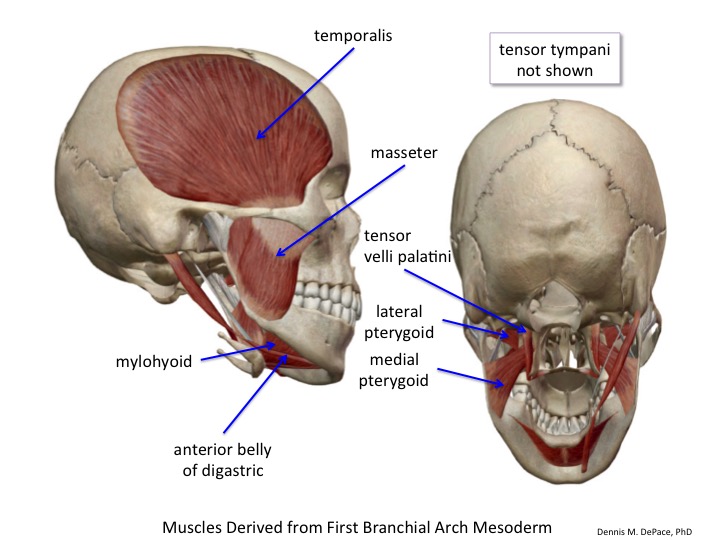
    The mesodermal mesenchyme of the first arch gives rise to eight pairs of muscles of the head region. Four of these pairs of muscles move the mandible during mastication and are called the muscles of mastication. They include the temporalis, masseter and the medial and lateral pterygoids. Four additional pairs of muscles develop from the mesenchyme. Anterior belly of digastric, mylohyoid, tensor velli palatini and tensor tympani.
    All of these muscles are innervated by the
    trigeminal nerve, CN V, the nerve of branchial arch I.

    Pouch Endoderm

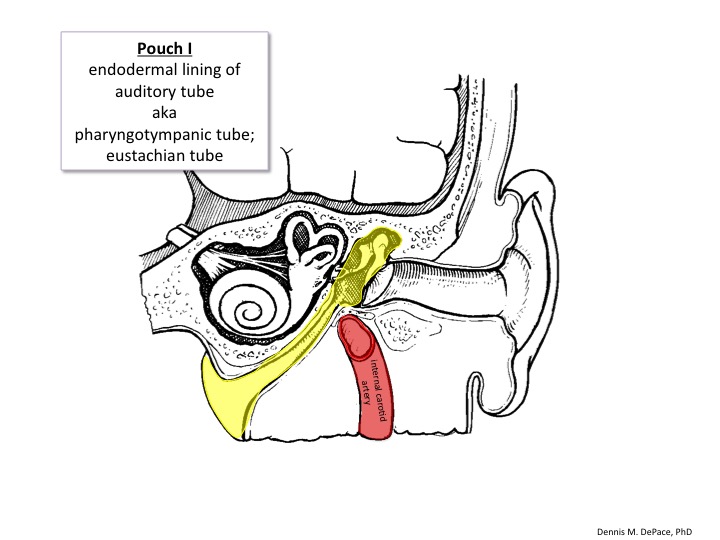
    The pharyngeal pouches are lateral out growths of the foregut region. As such, they are lined with endoderm. Each pharyngeal pouch differentiates into separate components of the head and neck. The endoderm of the first pharyngeal pouch forms the lining of the pharyngotympanic tube and middle ear cavity all highlighted in yellow.

    Stacks Image 60

    Groove Ectoderm

    Stacks Image 62

    The branchial grooves are ectodermally lined spaces between adjacent branchial arches. The ectoderm of the first branchial groove forms the lining of the external auditory meatus and lateral surface of the tympanic membrane all highlighted in blue in the diagram. The tympanic membrane is formed from ectoderm of the branchial groove, endoderm of the branchial pouch and intervening mesoderm.

    Stacks Image 56
  • Branchial (Pharyngeal )Arch II

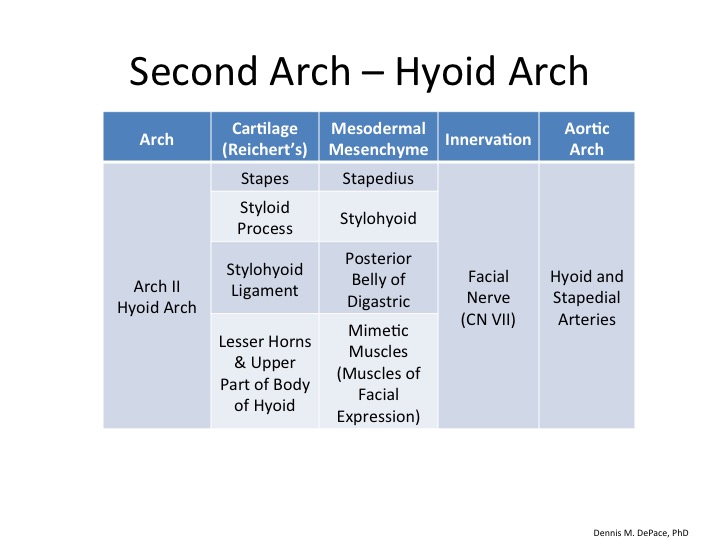
    The second branchial arch is known as the hyoid arch because it gives rise to parts of the hyoid bone and muscles that attach to it.

    Cartilage

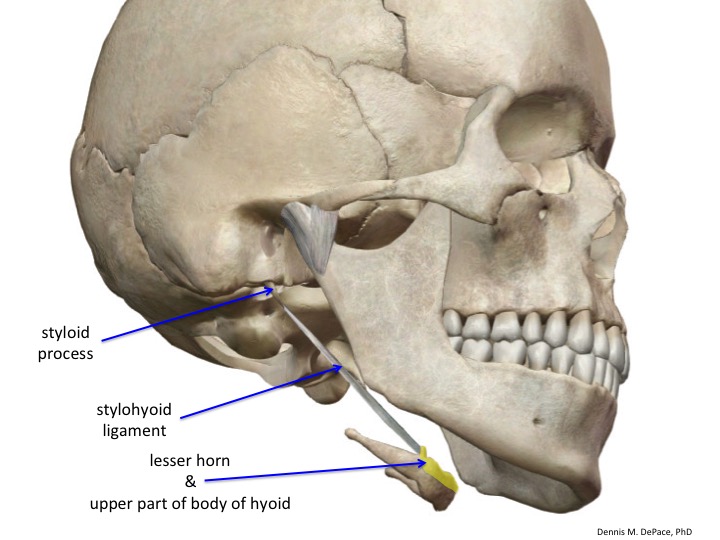
    The cartilage of the second arch, which is derived from neural crest, is known as Reichert's cartilage. It gives rise to the following structures:

    • stapes of the middle ear cavity (note that malleus and incus are from Arch I)
    • styloid process
    • stylohyoid ligament
    • lesser horn of hyoid bone
    • upper part of the body of the hyoid bone
    Stacks Image 73
    Stacks Image 75

    Mesenchyme

    Stacks Image 78

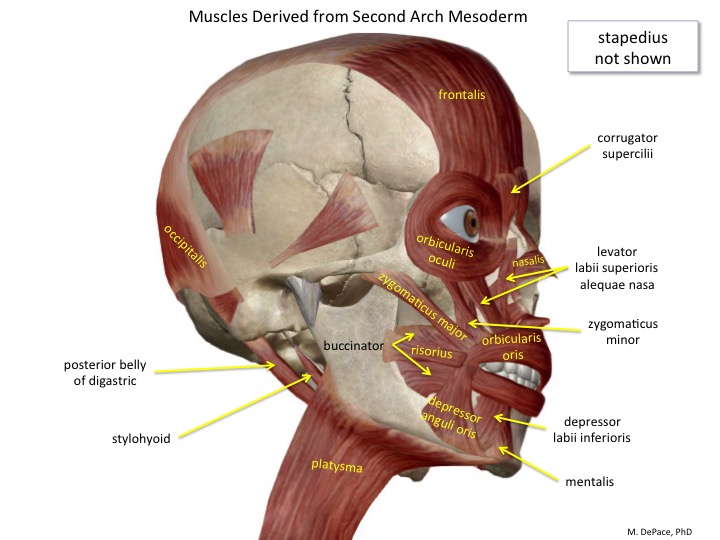
    Several pairs of muscles are derived from the mesenchyme of the second branchial arch. These include:

    • stapedius
    • stylohyoid
    • posterior belly of digastric
    • mimetic muscles, including
      • frontalis
      • orbicularis oris
      • orbicularis oculi
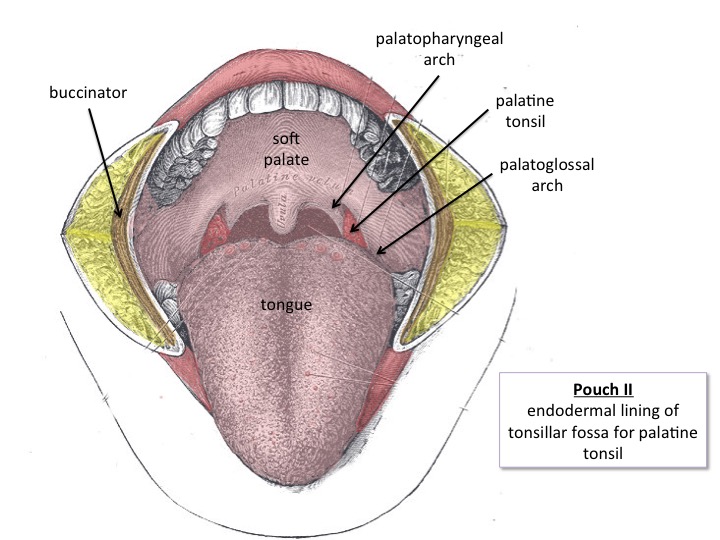
      • buccinator
    All are innervated by the nerve of the second arch, the facial nerve (CN VII).

    Pouch Endoderm

    The endoderm of the second pharyngeal pouch forms the lining of the tonsillar fossa for the palatine tonsils.
    Stacks Image 85
    Stacks Image 92
  • Branchial (Pharyngeal) Arch III

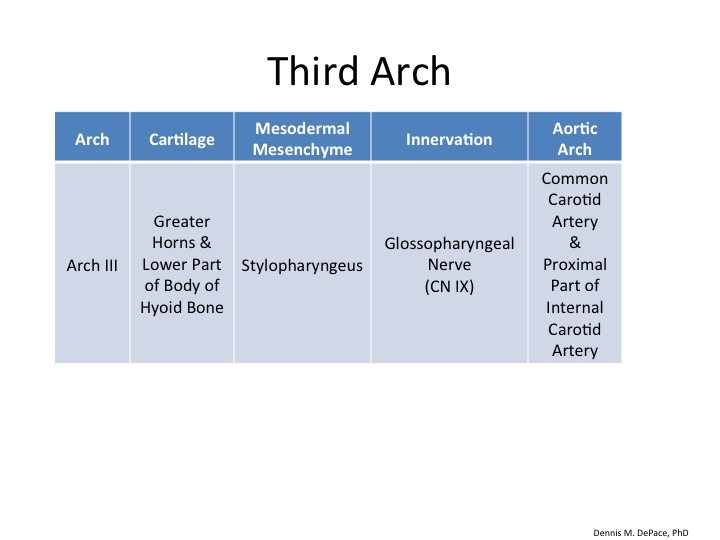
    The third branchial arch is not named. It’s cartilage forms a major portion of the hyoid bone. It’s mesoderm gives rise to a single muscle and it’s pouch forms the thymus and inferior parathyroid glands.

    Cartilage

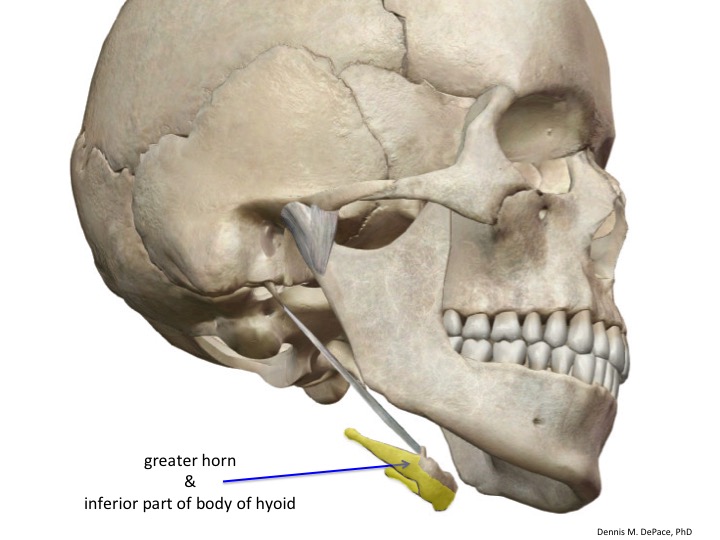
    The cartilage of the third branchial arch gives rise to the greater horn and inferior part of the body of the hyoid bone.

    Stacks Image 99

    Mesenchyme

    Stacks Image 112

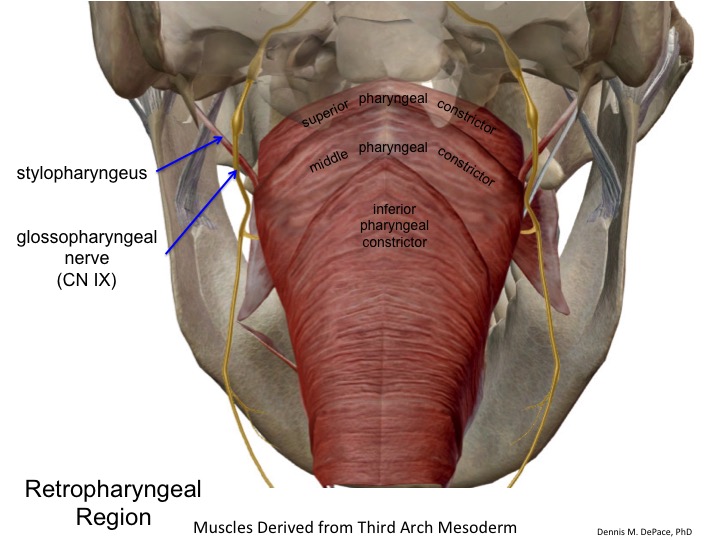
    The mesodermal mesenchyme of the third arch forms a single muscle, stylopharyngeus. This muscle is the only muscle innervated by the glossopharyngeal nerve (CN IX), the nerve of the third arch.

    Pouch Endoderm

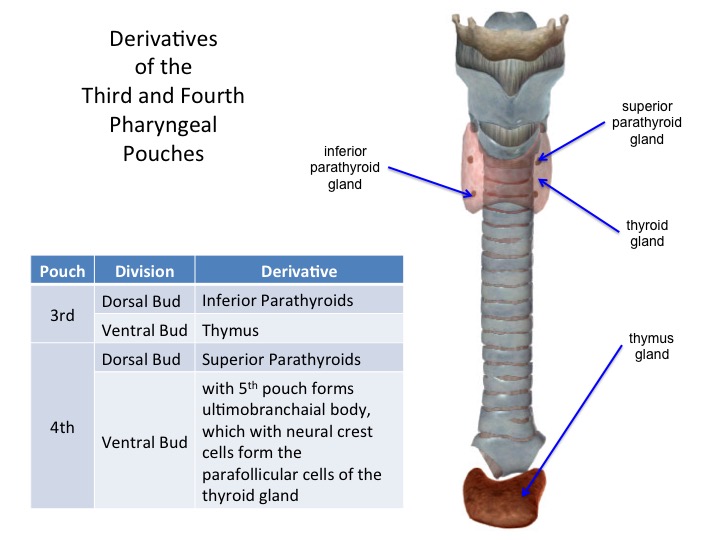
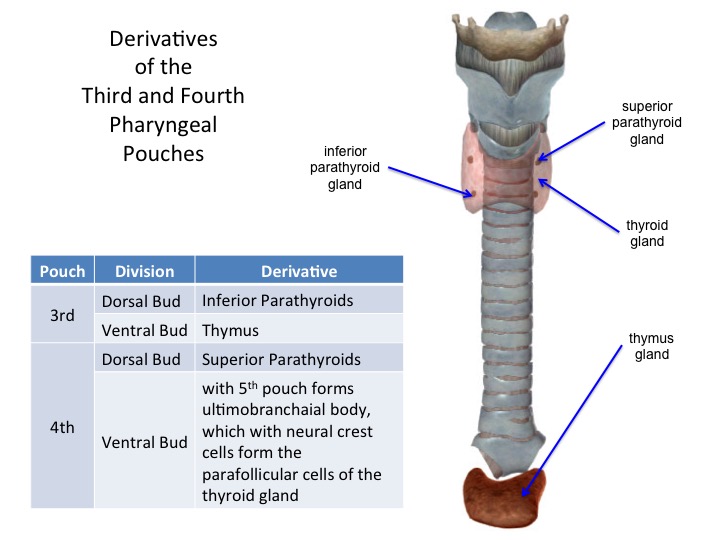
    The endoderm of the third pharyngeal pouch forms a dorsal bud and a ventral bud. The ventral buds of the third pouches, fuse in the midline and migrate into the superior mediastinum to form the thymus. The dorsal bud of each pouch forms an inferior parathyroid gland located behind the inferior pole of each lobe of the thyroid gland.

    Stacks Image 119
    Stacks Image 151
  • Branchial (Pharyngeal) Arches IV thru VI

    The third branchial arch is not named. It’s cartilage forms a major portion of the hyoid bone. It’s mesoderm gives rise to a single muscle and it’s pouch forms the thymus and inferior parathyroid glands.

    Cartilage

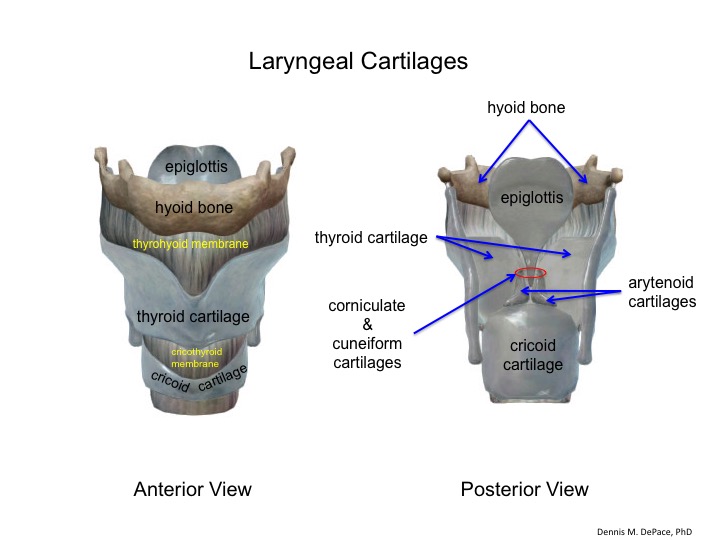
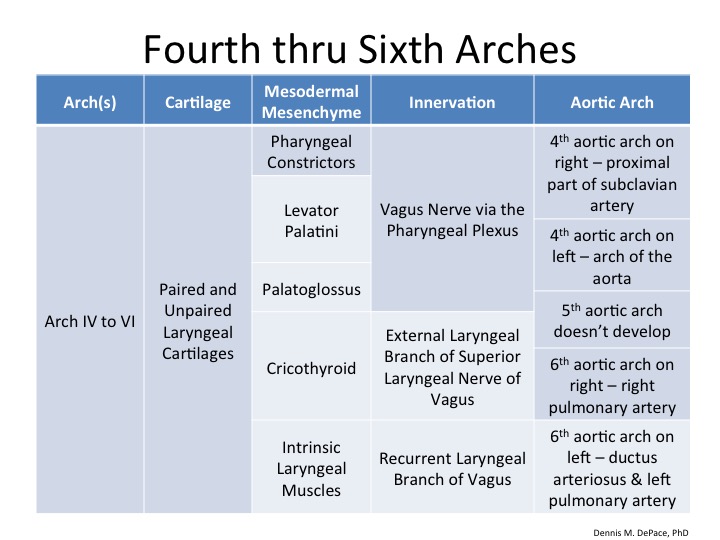
    The cartilages of the IV through VI arches remain as cartilage and for the skeleton of the larynx. The consist of both paired and unpaired cartilages.

    Stacks Image 130

    Mesenchyme

    Stacks Image 140
    Stacks Image 137

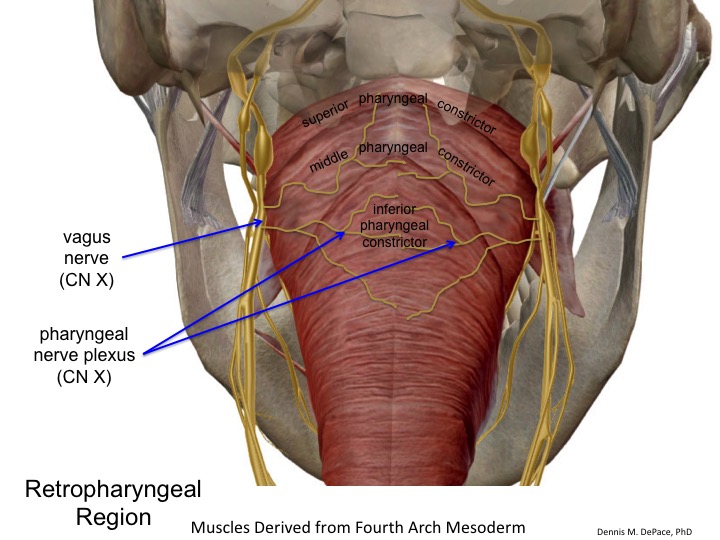
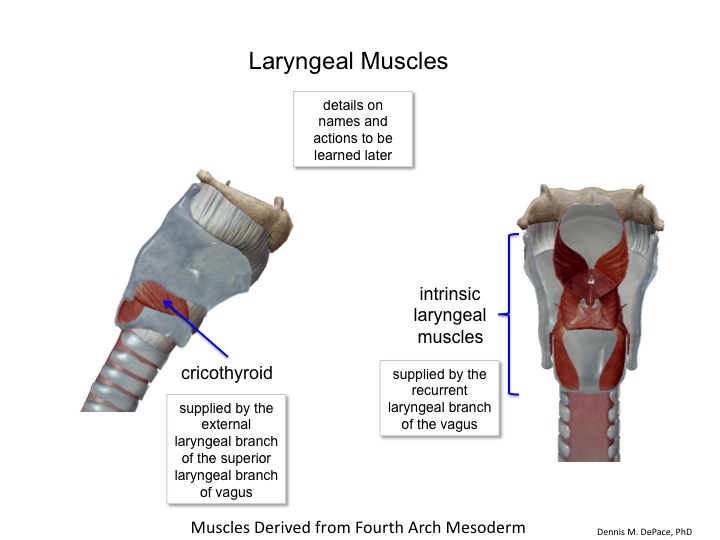
    The mesenchyme of the VI through VI branchial arches give rise to many muscles, all of which are innervated by branches of the vagus nerve (CN X) the nerve of these arches. These include the pharyngeal constrictors and the muscles of the larynx.

    Pouch Endoderm

    The fourth pharyngeal pouch forms a dorsal and ventral bud as does the third pouch. The dorsal buds of the fourth pharyngeal pouches form the superior parathyroid glands located behind the superior poles of the thyroid glands. The ventral buds of the fourth pharyngeal pouches interact with the endoderm of the fifth pharyngeal pouches and neural crest cells to form what is called the ultimobranchial body. This contributed to the development of the parafollicular (C-cells) of the thyroid gland.

    Stacks Image 146
    Stacks Image 149