Development of the Head and Neck
Development of the Head and Neck
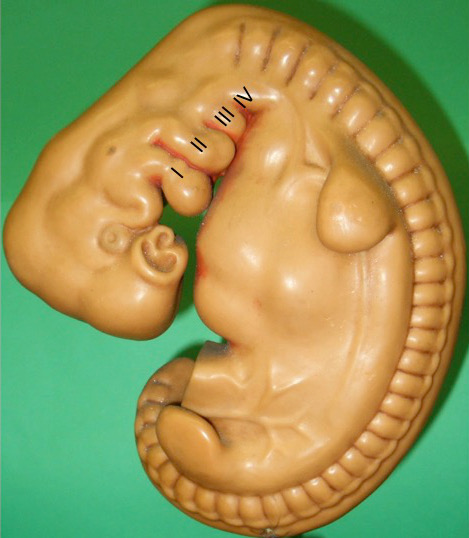
Development of the head and neck region involves the formation of six pairs of branchial (pharyngeal) arches in the head region of the developing embryo . These first appear around 5 weeks.
The branchial arches form major musculoskeletal components of the face and neck including the upper and lower jaws and the palate. In addition to the branchial arches, a large frontonasal prominence is responsible for development of the upper part of the face and the cranial vault.
The skeletal tissues of the head and neck are dependent upon the migration of neural crest cells from the developing forebrain. The neural crest cells contribute to the mesenchyme of the frontonasal prominence and branchial arches.
Establishment of the left to right axis of the head is guided by Sonic hedgehog secreted from the prochordal plate, that induces division of the forebrain into two telencephalic vesicles and a midline diencephalon..
Outgrowths of the diencephalon lead to the formation of the optic cups that ultimately form the retina and guide the formation of other parts of the eye from the surrounding tissues.
In the hind brain region, the otocysts, form the structures of the inner ear, while the ear ossicles develop from the cartilages of the first and second branchial arches.